Board layout design plays a critical role in the success of football board games.
Whether the game is inspired by American football or soccer, the layout of the board directly affects gameplay clarity, player engagement, and overall immersion.
Table of Contents
1. The Role of Board Layout in Football Board Games
In football board games, the board functions as the central interface between players and the game system. It represents the field of play, tracks progress, displays tactical options, and communicates game states.
Unlike digital games, board games rely entirely on visual and physical cues, making layout design especially important.
A strong board layout should:
- Clearly represent the football field or match structure
- Minimize confusion and rule lookups
- Support smooth turn flow and pacing
- Reinforce the theme and atmosphere of football
If players struggle to understand positioning, scoring, or movement because of a cluttered or unclear layout, even the best game mechanics can fall flat.
2. Representing the Football Field
Most football board games are built around a visual representation of the playing field. The design approach varies depending on the game’s complexity and realism.
Grid-Based Layouts
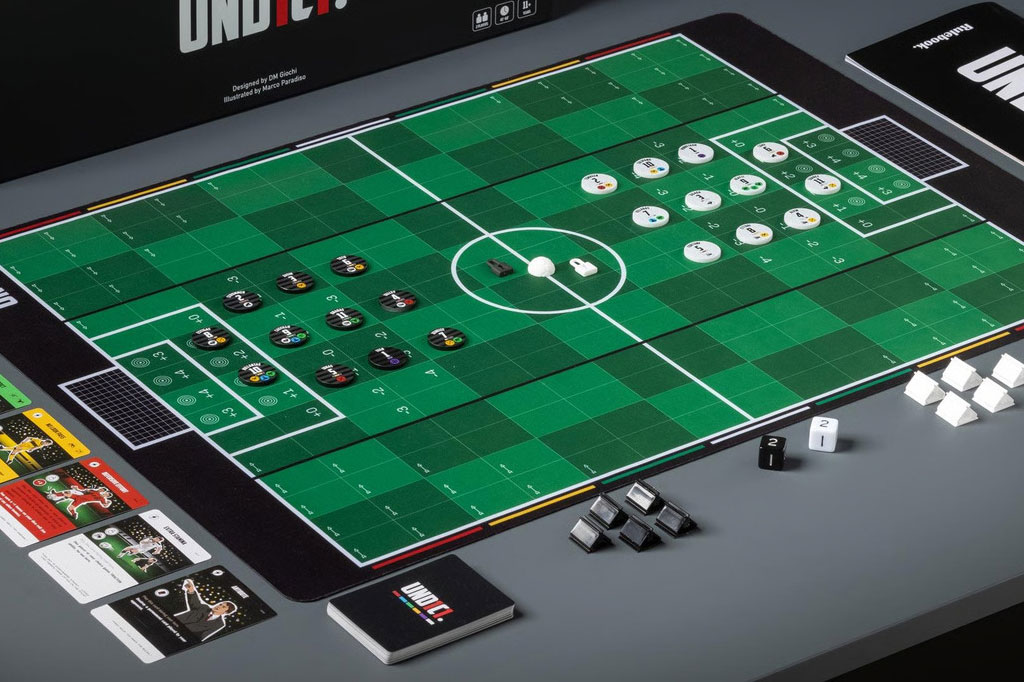
Many strategy-heavy football games use grids or zones to divide the field. These grids help define player movement, passing ranges, and tactical positioning. For example:
- Soccer games may use rectangular zones for defense, midfield, and attack.
- American football games may divide the field by yard lines or downs.
Grids should be subtle and easy to follow. Overly thick lines or excessive markings can distract players from the action.
Abstract Field Designs
Lighter or family-friendly football games often use abstract layouts rather than realistic fields. These designs focus on gameplay flow instead of simulation accuracy, using simplified areas such as “Attack,” “Defense,” or “Goal Chance” zones.
The key is consistency: whatever level of realism is chosen, the layout must clearly communicate how players interact with the field.
3. Clear Zones and Functional Areas
Beyond the field itself, football board games typically require additional areas on the board. These functional zones must be clearly separated and labeled.
Common zones include:
- Score tracks to record goals or points
- Turn or round trackers to show game progression
- Action spaces for drawing cards or resolving events
- Penalty or foul areas for rule enforcement
Good layout design ensures these zones are visually distinct but harmonized with the overall board. Using borders, color blocks, or icons helps players instantly recognize each area’s purpose.
4. Player Positioning and Movement Indicators
Movement is a core mechanic in football games, and the board layout must support it clearly. Players should always know:
- Where pieces can move
- How far they can move
- What actions are available from each position
Arrows, icons, or highlighted paths are often used to indicate legal movement or passing routes. In more advanced games, layered information—such as defensive pressure or offside zones—may also appear on the board.
To avoid visual overload, designers should:
- Use icons instead of text where possible
- Maintain consistent symbol usage throughout the board
- Leave enough white space for clarity
5. Visual Hierarchy and Information Clarity
A successful football board layout follows a strong visual hierarchy. This means the most important information stands out immediately, while secondary details remain accessible but unobtrusive.
Key priorities typically include:
- The playing field or main action area
- Scoring and game progress indicators
- Supporting information (icons, reminders, references)
Typography, color contrast, and line weight all contribute to hierarchy. For example, goal areas may use bold colors, while background elements remain muted. Fonts should be readable at a distance and consistent with the theme of the game.
6. Thematic Consistency and Immersion
Football is a highly emotional and visual sport, and board layout design should reflect that energy. A cohesive theme enhances immersion and makes the game more memorable.
Design elements that support theme include:
- Grass textures, pitch markings, or stadium graphics
- Team colors and jersey-inspired accents
- Dynamic illustrations suggesting motion and impact
However, visual flair should never interfere with usability. High-contrast markings, clear boundaries, and readable text must always take priority over decoration.
7. Adaptability for Different Game Modes
Many football board games offer multiple modes, such as quick matches, tournaments, or campaign play. The board layout should support these variations without requiring entirely new boards.
Design strategies include:
- Modular boards that can be rearranged
- Dual-purpose tracks usable for different modes
- Neutral design elements that work across scenarios
This flexibility increases replay value and makes the game more appealing to a wider audience.
8. Player Perspective and Table Presence
Board layout design must also consider how players physically interact with the board. A football board game is usually viewed from multiple sides of the table, so orientation matters.
Important considerations include:
- Symmetrical layouts so no player has a visual disadvantage
- Rotated text or icon-only labels to avoid upside-down reading
- Centralized scoring areas visible to all players
A strong table presence—meaning the board looks engaging and readable at a glance—helps draw players in and keeps them focused throughout the match.
9. Prototyping and Playtesting the Layout
No board layout design is complete without extensive playtesting. Designers should prototype early and observe how real players interact with the board.
Key questions during testing:
- Do players understand where to place pieces without explanation?
- Are any areas consistently overlooked or misunderstood?
- Does the layout slow down or speed up gameplay?
Feedback from playtesting often reveals issues that are not obvious during the design phase, such as overcrowded zones or unclear movement paths.