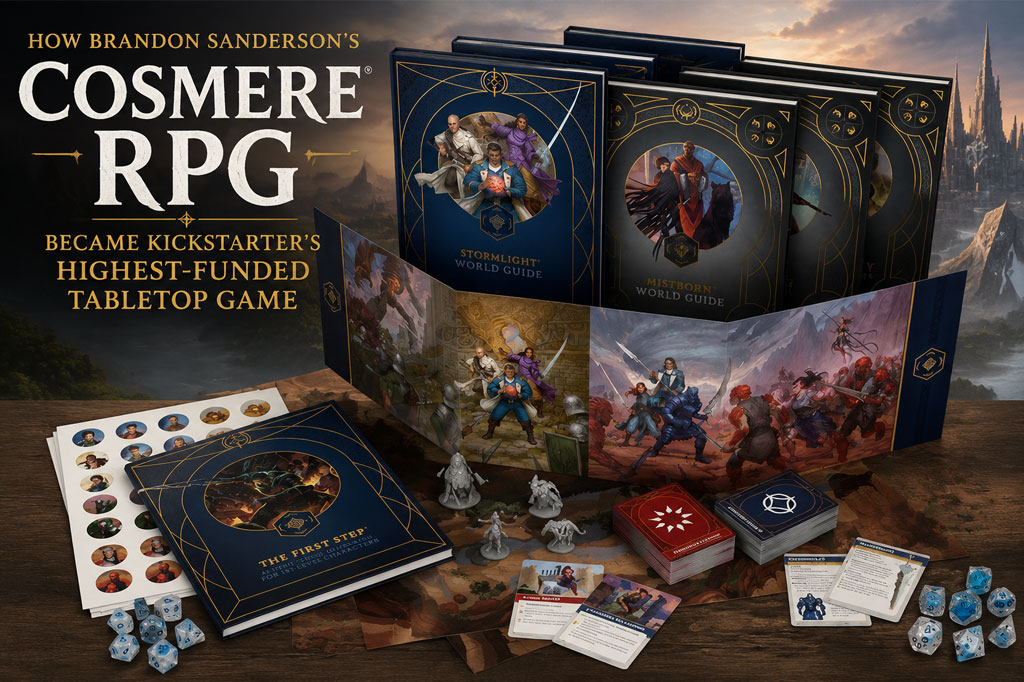
In August 2024, Brotherwise Games launched Brandon Sanderson’s Cosmere® RPG on Kickstarter with an initial funding goal of $250,000.
Twenty-three days later, the campaign had raised $15,149,874 from 55,106 backers—more than 60 times its original goal. Kickstarter subsequently identified it as the highest-funded tabletop games project in the platform’s history.
The numbers are extraordinary, but the campaign’s success cannot be explained by Brandon Sanderson’s popularity alone. It resulted from the alignment of a powerful intellectual property, a highly engaged community, an experienced product partner, an inclusive reward structure and a product designed as the beginning of a long-term ecosystem.
What can tabletop game creators and publishers learn from this record-breaking campaign?
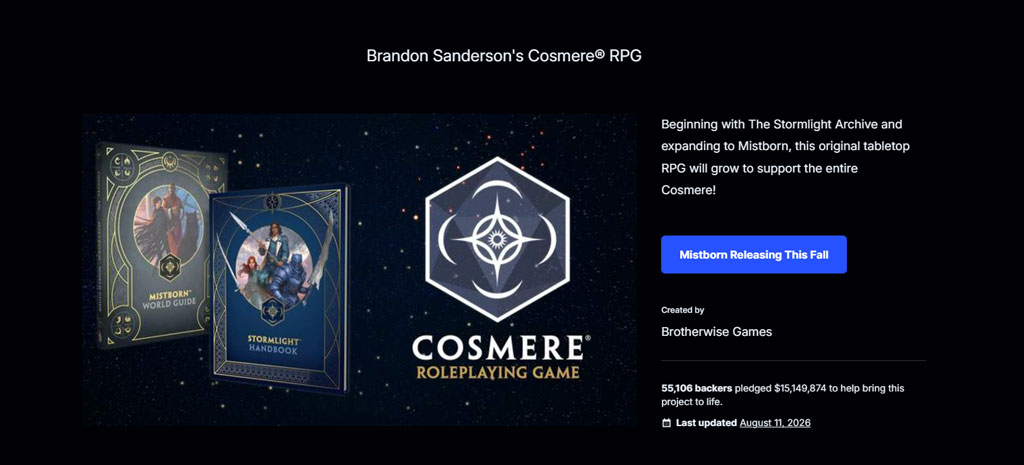
The Campaign at a Glance
- Project: Brandon Sanderson’s Cosmere® RPG
- Creator: Brotherwise Games
- Original goal: $250,000
- Final amount pledged: $15,149,874
- Backers: 55,106
- Campaign duration: 23 days
- Funding multiple: Approximately 60.6 times the original goal
- Average pledge per backer: Approximately $275
The average pledge is particularly revealing. This was not simply a campaign that attracted many fans at a low entry price. It successfully encouraged a significant portion of its audience to select premium bundles containing multiple books, adventures, dice, maps and accessories.
1. It Started with an Exceptionally Strong Intellectual Property
The Cosmere is not a single novel or isolated fantasy setting. It is an interconnected universe spanning series such as The Stormlight Archive and Mistborn.
This gave the campaign several advantages before it even launched:
- A large international audience already understood the setting.
- Fans had years of emotional investment in its characters and worlds.
- The Cosmere contained enough locations, cultures and magic systems to support a large RPG product line.
- New books could continue generating attention for the tabletop game.
- The game offered fans a new way to experience a world they already loved.
This matters because crowdfunding is partly a question of trust. Unknown creators must first persuade visitors to care about their fictional universe. The Cosmere campaign began with an audience that was already interested.
However, brand recognition alone does not guarantee a successful tabletop adaptation. Fans also need to believe that the creators understand and respect the original material.
2. The Game Was Treated as Canonical Content
The campaign did not position the RPG as an unrelated licensed product with a recognizable logo attached to it. Brotherwise Games and Dragonsteel developed it as an authentic extension of the Cosmere.
The setting guides contained new lore and artwork. Brandon Sanderson and author Dan Wells helped create the story for the first hardcover adventure, Stonewalkers. According to Kickstarter, that adventure also provided additional context for events connected to Wind and Truth.
This expanded the potential market beyond active role-playing gamers.
A traditional RPG customer might purchase the books to run a campaign. A Sanderson reader who had never played an RPG might still want the World Guides for their artwork and canonical information. A collector might want premium physical editions simply because they belonged on a “Sandershelf.”
The product therefore served at least three overlapping audiences:
- Experienced tabletop RPG players
- First-time players attracted by the Cosmere
- Readers and collectors interested in official lore and artwork
That audience expansion was one of the campaign’s most effective commercial decisions.
3. It Combined a Famous Creator with an Experienced Game Company
Brandon Sanderson supplied the universe, audience and creative authority. Brotherwise Games supplied tabletop development, production experience and product management.
This was not the first time the companies had worked together. Their relationship had already developed through projects including Call to Adventure: The Stormlight Archive and a previous Stormlight miniatures campaign.
Sanderson has described Brotherwise as a knowledgeable and responsive partner that understood both the source material and Dragonsteel’s objectives. He also explained that the relationship was a close partnership rather than a conventional arrangement in which rights were licensed and the finished product was developed at a distance.
That history reduced risk in two ways.
First, Dragonsteel could trust Brotherwise to represent the Cosmere appropriately. Second, fans could see evidence that the companies had already created and delivered physical products together.
For creators, the broader lesson is important: choose partners whose capabilities complement your own.
A great writer does not automatically have expertise in game mechanics, prepress, miniature production, packaging or international logistics. Similarly, an experienced game publisher cannot manufacture authentic engagement with an intellectual property it does not understand.
The strongest partnership combines creative authority with operational competence.
4. The Product Was Designed for Both Familiarity and Innovation
The Cosmere RPG did not rely entirely on its license. It introduced an original role-playing system developed by an experienced design team.
The system retained elements familiar to RPG players, including character levels and d20-based skill tests. At the same time, it introduced features such as:
- Fail-forward outcomes
- A narrative “plot die”
- Skill-based magic systems
- Flexible talent trees instead of rigid character classes
This balance lowered the barrier to entry. Familiar mechanics made the game easier to understand, while new systems gave experienced players a reason to pay attention.
That is a useful principle for any tabletop product:
Familiarity helps customers understand a game; innovation gives them a reason to buy it.
A campaign that is completely unfamiliar may be difficult to explain. A game that feels entirely derivative may struggle to generate excitement. The Cosmere RPG occupied the valuable space between those two extremes.
5. The Reward Structure Captured Different Types of Demand
One of the campaign’s smartest decisions was not forcing every backer into the same product configuration.
Lower pledge levels allowed customers to select individual books. Readers who mainly wanted lore and artwork could purchase World Guides. Players could choose the core materials required to begin a campaign. Higher tiers included additional books, adventures and physical accessories covering both Stormlight and Mistborn releases.
This structure created a natural customer ladder:
- Entry-level products reduced the cost of participation.
- Core bundles provided a clear starting point for players.
- Premium bundles increased order value among dedicated fans.
- Accessories appealed to collectors and gift buyers.
- Multi-setting packages established demand for future releases.
Based on the final campaign total and backer count, the calculated average contribution was approximately $275 per backer. This suggests the campaign did more than attract a large audience—it converted that audience into high-value physical orders.
For tabletop creators, the lesson is not simply to create more reward tiers. Too many confusing combinations can reduce conversions and create serious fulfillment problems.
The goal is to create a clear progression in which each higher tier offers an understandable increase in value.
6. It Was Presented as a Long-Term Product Ecosystem
The campaign began with The Stormlight Archive and expanded into Mistborn, but its ambition extended much further.
Sanderson described the RPG as a long-term endeavor intended to receive support for as long as he continued writing Cosmere books. The campaign therefore represented entry into an expanding platform rather than the purchase of a one-time product.
This changed the value proposition.
Backers were not only buying rulebooks. They were supporting the foundation for:
- Additional Cosmere settings
- New adventures
- Future accessories
- New characters and magic systems
- Continuing community content
- Potentially years of product releases
An ecosystem strategy can make a crowdfunding campaign more attractive because customers see continued value beyond the first delivery. It can also improve the publisher’s economics: core systems, visual standards and component formats may be reused across future releases.
However, creators should only promise a long-term roadmap when they have the capacity to support it. A credible ecosystem requires consistent development, manufacturing and communication.
7. The Campaign Benefited from Accumulated Community Trust
Brandon Sanderson was already one of the most successful creators in crowdfunding history. His earlier “Surprise! Four Secret Novels” campaign raised more than $41 million.
That previous success mattered because crowdfunding customers do not evaluate only the new product. They also evaluate the creator’s history.
Sanderson’s team had built trust through:
- Regular project updates
- Direct communication with fans
- Livestreams and convention appearances
- Transparent discussions about production
- Previously delivered books and merchandise
- An established direct-to-consumer infrastructure
The RPG was also promoted through Sanderson’s existing communication channels and appeared at major fan and gaming events. The campaign therefore launched into an active community rather than attempting to create one during its 23-day funding period.
This is one of the less glamorous but most important lessons from the case:
A successful crowdfunding campaign usually begins long before the Kickstarter page goes live.
Creators should build mailing lists, share development progress, demonstrate prototypes and develop relationships with reviewers and players before launch.
8. The Physical Products Made the Fictional World Tangible
A tabletop RPG may be based on storytelling, but the campaign’s commercial performance was heavily influenced by physical product design.
Its product range included books, dice, maps, tokens and other play accessories. These items transformed an intangible fictional universe into something fans could display, collect and use.
For premium tabletop products, physical quality communicates brand value. Buyers judge details such as:
- Book binding and paper selection
- Color consistency across multiple volumes
- Box and slipcase construction
- Dice clarity and finish
- Map folding and durability
- Token thickness and cutting accuracy
- Insert organization
- Packaging protection during shipping
When an average backer spends hundreds of dollars, manufacturing quality becomes part of the campaign promise.
A visually impressive campaign can secure a pledge, but only a well-manufactured product can justify that pledge when the package arrives.
What Other Creators Can—and Cannot—Copy
It would be unrealistic to conclude that any designer can raise $15 million by following the same campaign structure. Most creators do not begin with a bestselling fantasy universe or an audience of Sanderson’s scale.
Several advantages were difficult to replicate:
- A globally recognized author
- A large existing fan community
- Years of established Cosmere storytelling
- Previous record-breaking crowdfunding campaigns
- Extensive direct marketing channels
- Strong internal creative and fulfillment infrastructure
Nevertheless, many of the project’s strategic principles are transferable.
Creators can:
- Define a clear target audience before development.
- Build a community before launching.
- Work with specialists who complement their capabilities.
- Create a professional prototype for marketing and testing.
- Offer accessible entry products alongside premium bundles.
- Make reward tiers easy to understand.
- Design products that appeal to more than one customer segment.
- Plan expansions without overpromising.
- Align stretch goals with production capacity.
- Confirm manufacturing and logistics costs before setting prices.