Turning a board game prototype into a commercial product involves dozens of decisions, but one of the most important is where to manufacture it.
For publishers and independent creators, the choice often comes down to three major options: China, the United States, or Europe.
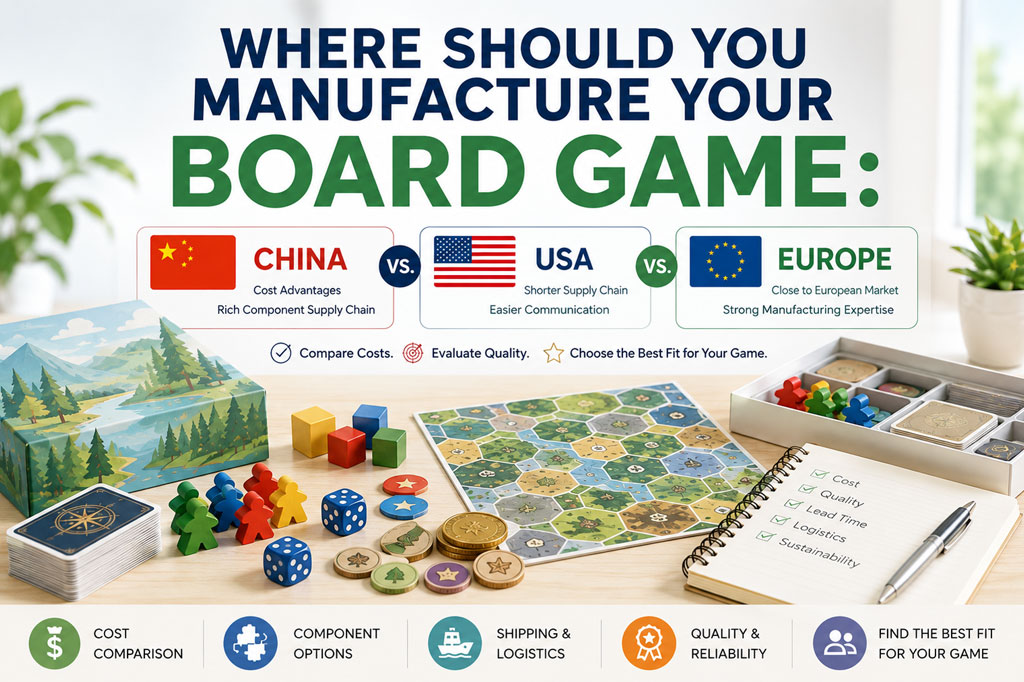
Each manufacturing region has its own strengths. China is known for competitive pricing, extensive component supply chains, and experience with complex custom games. The USA can offer shorter domestic supply chains and easier communication for North American publishers. Europe combines established game manufacturing expertise with proximity to the European market.
However, there is no single manufacturing location that is best for every project.
The right choice depends on factors such as:
- Order quantity
- Game complexity
- Component materials
- Customization requirements
- Target market
- Production schedule
- Freight costs
- Sustainability requirements
- Budget
This guide compares board game manufacturing in China vs. USA vs. Europe to help creators and publishers make a more informed decision.
China vs. USA vs. Europe: Quick Comparison
| Factor | China | USA | Europe |
|---|---|---|---|
| Manufacturing cost | Generally lower | Generally higher | Medium to high |
| Custom components | Excellent | Moderate | Good |
| Supply chain depth | Excellent | Moderate | Good |
| Small production runs | Possible, depending on factory | Often suitable | Often suitable |
| Large production runs | Excellent | Good | Excellent |
| Complex plastic components | Excellent | More limited | Good |
| Custom miniatures | Excellent | More limited | Good |
| Wooden components | Excellent | Available | Excellent |
| Communication | Requires overseas coordination | Convenient for US clients | Convenient for European clients |
| Shipping to North America | Longer international freight | Fast domestic logistics | International freight required |
| Shipping to Europe | International freight required | International freight required | Fast regional logistics |
| Best suited for | Highly customized and cost-sensitive games | US-focused/local production | European distribution and regional production |
These are broad tendencies rather than universal rules. Individual manufacturers can differ significantly in capabilities, pricing, minimum order quantities, and lead times.
1. Manufacturing Board Games in China
China has developed one of the world’s most comprehensive manufacturing ecosystems for board games, card games, puzzles, and tabletop accessories.
A major advantage is not simply lower labor costs. It is the concentration of specialized suppliers capable of producing different components within the same supply chain.
A modern board game may contain:
- Game boards
- Playing cards
- Punchboards
- Custom boxes
- Plastic miniatures
- Acrylic tokens
- Wooden meeples
- Metal coins
- Dice
- Rulebooks
- Plastic inserts
- Fabric bags
- Stickers
Producing all of these components requires very different manufacturing processes.
Chinese board game manufacturers can often coordinate these processes through established networks of printing, plastics, wood, metal, packaging, and assembly suppliers.
Advantages of Manufacturing in China
Competitive Cost at Medium and Large Volumes
China can become particularly cost-effective as production quantities increase.
Tooling, printing setup, assembly, and material procurement costs can be distributed across hundreds or thousands of units, reducing the manufacturing cost per game.
This makes China particularly attractive for publishers planning:
- Kickstarter campaigns
- Retail launches
- International distribution
- Reprints of established games
- Production runs of 300+ units
Some manufacturers also accept smaller runs, although minimum order quantities vary considerably depending on components and processes.
Strong Customization Capabilities
Customization is one of China’s biggest advantages.
A relatively simple card game can be manufactured almost anywhere. But once a project includes unusual components, finding the right production ecosystem becomes more important.
For example, a publisher may want:
Custom metal coins + acrylic tokens + wooden meeples + printed cards + magnetic box + vacuum-formed insert.
Instead of sourcing each component independently, an experienced board game manufacturer can coordinate production and final assembly.
This is particularly valuable for premium Kickstarter games where creators frequently use distinctive components to increase perceived value.
Mature Supply Chain
China has extensive supplier networks for paper, plastics, wood, acrylic, metal, textiles, packaging, and printing.
This creates another important advantage: component flexibility.
If one material or production method is too expensive, the manufacturer may be able to recommend alternatives.
For example:
Custom metal token → wooden token → acrylic token → punchboard token
The gameplay function remains similar, but the cost and appearance can change substantially.
This allows creators to optimize a game’s Bill of Materials without completely redesigning the product.
Challenges of Manufacturing in China
The biggest consideration is distance from major Western markets.
Games manufactured in China typically need to travel by sea, rail, air, or multimodal freight before reaching fulfillment centers.
Publishers therefore need to consider:
- International freight
- Customs clearance
- Import duties and taxes
- Port delays
- Freight insurance
- Warehousing
- Final-mile fulfillment
Communication and quality control also require careful management.
Creators should work with manufacturers that provide clear specifications, pre-production samples, production updates, and final inspections.
For complex games, approving a physical production sample before mass manufacturing is especially important.
2. Manufacturing Board Games in the USA
For publishers primarily selling in North America, manufacturing in the United States can simplify parts of the supply chain.
Instead of manufacturing overseas and importing finished games, products can move directly from the factory to domestic warehouses, distributors, retailers, or fulfillment centers.
Advantages of Manufacturing in the USA
Shorter Supply Chain for US Publishers
Domestic production can reduce exposure to international logistics disruptions.
Publishers may avoid or reduce concerns related to:
- Ocean freight
- Port congestion
- International customs procedures
- Long overseas transit times
- Large fluctuations in international freight rates
This can make inventory planning easier.
For games with predictable domestic demand, shorter replenishment cycles may also allow publishers to maintain lower inventory levels.
Easier Communication
Time-zone differences can complicate international projects.
Manufacturing domestically can make meetings, factory visits, sampling discussions, and production troubleshooting easier for US-based creators.
This can be particularly valuable during early product development.
“Made in USA” Positioning
For certain audiences, domestic manufacturing itself can become part of the product’s marketing strategy.
Some publishers deliberately choose US production because their customers value local manufacturing, shorter supply chains, or domestic sourcing.
However, publishers should verify applicable labeling requirements before making specific country-of-origin claims.
Challenges of Manufacturing in the USA
Cost is often the biggest limitation.
Labor-intensive processes such as manual assembly can significantly increase manufacturing costs.
Complex games may also require components that are not economically available from a single domestic supply chain.
For example, a game containing:
- 20 custom miniatures
- Custom dice
- Metal coins
- Wooden pieces
- Acrylic markers
- Premium inserts
may require multiple specialist suppliers.
In some cases, components may still need to be imported even if printing and final assembly occur in the USA.
Therefore, domestic manufacturing can be particularly attractive for games with relatively straightforward components, but the economics can become more challenging as component complexity increases.
3. Manufacturing Board Games in Europe
Europe has a long history of board game publishing and manufacturing, supported by a strong tabletop gaming market.
Countries including Germany, Poland, the Czech Republic, Spain, and others have established printing, packaging, woodworking, plastics, and game manufacturing capabilities.
Advantages of Manufacturing in Europe
Strong Board Game Manufacturing Expertise
European manufacturers have extensive experience producing:
- Eurogames
- Strategy games
- Card games
- Children’s games
- Educational games
- Puzzles
For traditional paper-heavy board games involving cards, boards, boxes, punchboards, wooden pieces, and rulebooks, Europe can be highly competitive from a quality perspective.
Excellent Option for European Distribution
If most customers are located in Europe, manufacturing within the region can substantially simplify logistics.
Instead of importing thousands of games from another continent, publishers can move inventory more efficiently to European distributors and fulfillment centers.
This can be particularly valuable for established publishers with predictable European sales volumes.
Strong Paper and Wooden Component Manufacturing
Europe has particularly strong capabilities in printing, paperboard conversion, packaging, and wooden game pieces.
Publishers producing classic Euro-style games may therefore find European factories highly suitable.
Challenges of Manufacturing in Europe
Production costs can be higher than in China, especially for games requiring significant manual assembly or highly customized components.
The supply chain for specialized accessories may also be less concentrated.
A game consisting primarily of:
cards + punchboards + wooden meeples + standard dice
may be relatively straightforward to manufacture regionally.
A game containing:
custom miniatures + metal coins + acrylic components + electronics + unusual packaging
may require a broader network of suppliers or imported components.
4. Which Region Is Cheapest for Board Game Manufacturing?
Creators often ask:
Is manufacturing board games in China always cheaper?
Not necessarily.
The factory quotation is only one part of the total cost.
A better comparison is:
Total Landed Cost = Manufacturing + Tooling + Packaging + Freight + Duties/Taxes + Inspection + Warehousing + Fulfillment-related costs
Imagine two hypothetical quotations:
Factory A: $8.00 per game
Factory B: $10.00 per game
Factory A appears 20% cheaper.
But after international freight, customs, inspection, and additional logistics, its landed cost could become $10.50.
If Factory B is located near the target market and reaches the warehouse at $10.20, Factory B may actually be the less expensive option overall.
Publishers should therefore compare landed costs rather than unit manufacturing prices alone.
5. Game Complexity May Matter More Than Geography
One of the biggest mistakes creators make is choosing a manufacturing country before analyzing the game’s components.
Consider two products.
Game A
- 120 cards
- Rulebook
- Foldable game board
- 4 punchboards
- Standard dice
- Standard box
Game B
- 250 cards
- 20 custom miniatures
- 12 custom dice
- 40 wooden meeples
- 30 acrylic tokens
- 20 metal coins
- Custom plastic insert
- Magnetic rigid box
Game A can potentially be manufactured efficiently in many regions.
Game B requires a much broader manufacturing ecosystem.
For complex games, supplier coordination can become just as important as printing quality.
This is one reason many highly customized crowdfunding games are manufactured in China: the advantage is not simply price, but access to multiple production processes through a relatively concentrated supply chain.
China vs. USA vs. Europe: Which Should You Choose?
There is no universal winner.
Choose China when:
- Your game contains many custom components.
- You need miniatures, metal pieces, acrylic components, or unusual accessories.
- You are producing medium or large quantities.
- Manufacturing cost is a major consideration.
- You need a supplier capable of coordinating multiple production processes.
- You are preparing a component-heavy Kickstarter game.
Choose the USA when:
- Your primary market is North America.
- Short domestic supply chains are important.
- Your game has relatively straightforward components.
- You need faster communication with a domestic supplier.
- Local manufacturing is important to your brand positioning.
Choose Europe when:
- Your primary market is European.
- Your game relies heavily on printed and wooden components.
- You want production close to European fulfillment and distribution.
- You are producing traditional card, strategy, family, or Euro-style games.
- Regional sourcing is part of your supply-chain strategy.
For some larger publishers, the answer may even be more than one region.
An established game could initially be manufactured in China and later use regional production for specific editions or markets. Alternatively, individual components could be sourced globally while final production takes place closer to customers.
Final Thoughts
The question should not simply be:
“Which country can manufacture my board game cheapest?”
A better question is:
“Which manufacturing ecosystem gives my game the best combination of cost, quality, customization, scalability, and logistics?”
For a simple card game sold mainly in the United States, domestic manufacturing may be perfectly reasonable.
For a traditional strategy game targeting European retailers, a European manufacturer may offer an excellent combination of quality and logistics.
For a complex Kickstarter game containing custom miniatures, wooden pieces, acrylic tokens, metal components, cards, boards, and premium packaging, China’s broad supply chain can offer significant advantages.
Ultimately, the right decision comes from evaluating the entire project—not simply comparing factory quotations.