Great board game artwork rarely begins with the illustrator opening a blank canvas. It begins with a clear art brief.
For a board game designer, an art brief is the bridge between the game in your head and the visual world that players will eventually see. It tells the illustrator what needs to be created, what the game should feel like, how individual illustrations will be used, and which creative decisions are flexible or fixed.
If you are preparing to commission artwork for your board game, here is how to build a professional art brief.
1. Start With a Short Overview of the Game
Before discussing individual illustrations, give the artist context.
An illustrator who understands the game can make better visual decisions than one who receives a spreadsheet containing only filenames and dimensions.
Your introduction should briefly explain:
- Game title
- Type of game
- Number and age of players
- Typical playing time
- Theme and setting
- Core gameplay concept
- Target audience
- Intended market
- Current development stage
This takes only a few paragraphs but immediately gives the illustrator a much stronger foundation.
2. Explain the Visual Goal
Next, describe what players should feel when they first see the game.
Do not rely only on broad terms such as:
“Beautiful fantasy artwork.”
That description could mean almost anything.
Instead, define the intended visual personality more precisely.
Is the game:
- Dark and mysterious?
- Bright and playful?
- Historical and realistic?
- Cute and humorous?
- Minimalist and sophisticated?
- Epic and cinematic?
- Handcrafted and nostalgic?
- Educational and approachable?
You can also explain what the artwork should not feel like.
For example:
The game should feel adventurous but not aggressive. Characters can be exaggerated and expressive, but they should not look childish. The world should feel magical without becoming high fantasy.
Negative direction is often surprisingly useful because it establishes creative boundaries.
3. Create a Visual Reference Board
Words alone are rarely enough to communicate an art direction.
Prepare a small collection of reference images showing the visual qualities you want. These might include:
- Illustration styles
- Character designs
- Color palettes
- Environments
- Architecture
- Clothing
- Historical objects
- Lighting
- Textures
- Packaging
- Other board games
- Films, animation, comics, or books
However, references should communicate direction rather than imitation.
Instead of saying:
“Make it exactly like this game.”
Explain what you like about each reference.
For example:
Reference A — I like the warm color palette and soft lighting.
Reference B — I like the simplified character proportions.
Reference C — This is a useful reference for the architecture, but not for the illustration style.
This helps the illustrator understand which elements matter.
4. Define Your Art Style More Precisely
A professional brief should translate your visual references into practical artistic characteristics.
Consider specifying areas such as:
Rendering style
Flat, painterly, line-based, cel-shaded, textured, watercolor-inspired, digitally painted, or semi-realistic.
Level of detail
Simple icons require very different treatment from large box-cover illustrations.
Character proportions
Realistic human proportions, slightly stylized, cartoon proportions, chibi, or highly exaggerated.
Color
Muted, pastel, saturated, earthy, high contrast, monochromatic, or another defined palette.
Lighting
Soft daylight, dramatic cinematic lighting, magical glow, flat graphic lighting, etc.
Linework
No visible outlines, thin clean lines, heavy comic outlines, sketch-like lines, and so on.
The objective is not to dictate every brushstroke. It is to create a consistent visual framework.
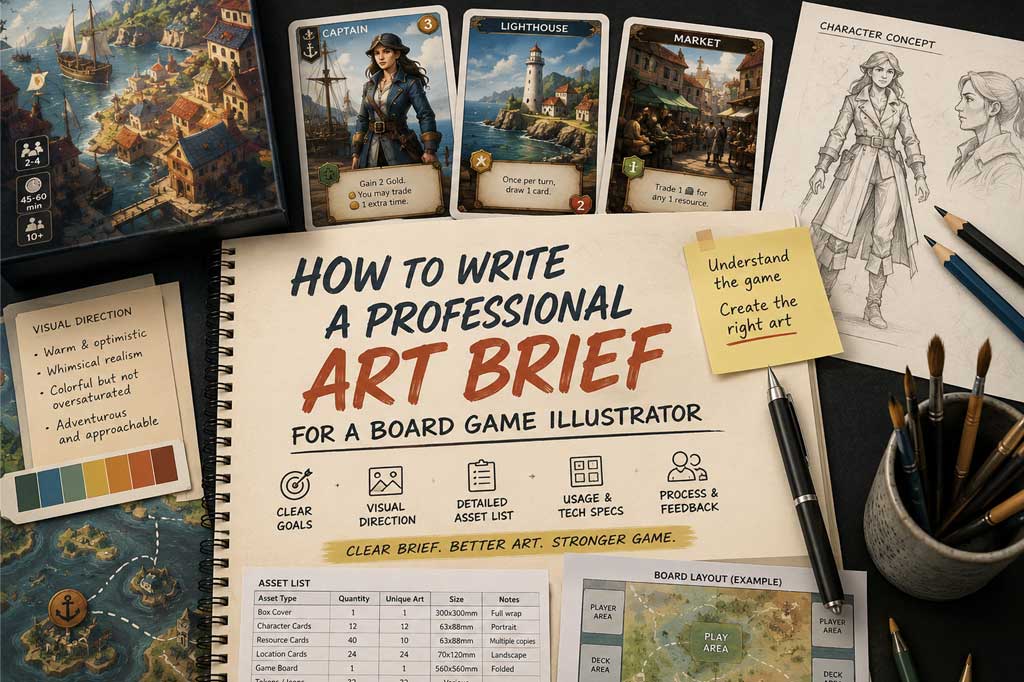
5. Prepare a Complete Asset List
One of the most important parts of the brief is the art asset list.
Before asking for a quote, determine as accurately as possible how much artwork your game actually requires.
For example:
| Asset Type | Quantity | Approx. Size | Unique Artwork |
|---|---|---|---|
| Box cover | 1 | 300 × 300 mm | 1 |
| Character cards | 12 | 63 × 88 mm | 12 |
| Resource cards | 40 | 63 × 88 mm | 10 |
| Location cards | 24 | 70 × 120 mm | 24 |
| Game board | 1 | 560 × 560 mm | 1 |
| Character portraits | 12 | — | 12 |
| Resource icons | 8 | — | 8 |
| Rulebook spot illustrations | 10 | Various | 10 |
The distinction between component quantity and unique artwork quantity is especially important.
A game containing 100 cards does not necessarily require 100 illustrations. If those cards reuse 20 illustrations, the artist needs to know that.
This information also makes quotations much more accurate.
6. Write an Individual Brief for Each Major Illustration
Each illustration description should answer four questions:
- What is shown?
- What is happening?
- What should the player feel?
- What must remain visually clear?
Do not over-direct details that have no effect on the game. A brief should provide clarity, not eliminate the illustrator’s creative judgment.
7. Tell the Illustrator Where the Artwork Will Be Used
Board game illustrations do not exist independently. They live inside components.
A beautiful illustration can become unusable if important details are hidden behind text, icons, borders, punchboard cuts, folds, or packaging edges.
Provide templates whenever possible.
For card artwork, show:
- Illustration area
- Text area
- Icon locations
- Card border
- Bleed
- Safe zone
For a game board, identify:
- Fold lines
- Paths
- Spaces
- Text locations
- Player areas
- Important gameplay information
For packaging, identify:
- Front panel
- Side panels
- Back panel
- Bleed
- Fold lines
- Barcode area
- Required legal or manufacturing information
The illustrator should understand not only what to draw but also how the illustration interacts with the final component.
8. Separate Illustration From Graphic Design
Board game creators sometimes treat illustration and graphic design as the same task, but they are different disciplines.
Illustration may include:
- Characters
- Environments
- Creatures
- Objects
- Decorative scenes
- Cover artwork
Graphic design may include:
- Card layouts
- Typography
- Icons
- Information hierarchy
- Rulebook layout
- Box layout
- Player aid design
Some artists provide both services, while others specialize in only one.
Your brief should clearly state what you expect.
For example:
The illustrator will provide character and environment artwork only. Card frames, typography, icons, and final card layouts will be handled by our graphic designer.
Clarifying this early prevents misunderstandings about scope and pricing.
9. Include Technical Specifications
Even if your illustrator is experienced with tabletop games, provide technical requirements.
Depending on the project, these can include:
- Final dimensions
- Resolution
- Color mode
- Bleed
- Safe zones
- File format
- Layer requirements
- Transparent backgrounds
- Naming conventions
- Source file requirements
For print artwork, 300 DPI is commonly used for raster images at final size, but the exact requirements should ultimately follow the specifications of your board game manufacturer and graphic production workflow.
If you already have production templates from your manufacturer, provide them to the illustrator.
This is particularly important for box artwork, boards, punchboards, and other components involving folds, cuts, or unusual shapes.
10. Explain Reusable Elements
Not every illustration needs to be created entirely from scratch.
A board game may contain recurring visual elements such as:
- Characters
- Backgrounds
- Buildings
- Weapons
- Resources
- Decorative borders
- Faction symbols
- Creatures
- Vehicles
Identify where elements can be reused or adapted.
For example, you might commission one full character design first and later request several poses or expressions based on the approved design.
Planning reusable assets can help maintain visual consistency and control the overall art budget.
A Simple Board Game Art Brief Template
A practical brief can follow this structure:
Project Information
- Game title
- Game type
- Target audience
- Player count
- Playing time
- Theme
- Short game description
Art Direction
- Desired style
- Mood
- Color direction
- Level of detail
- Character style
- Environment style
- Things to avoid
Asset List
- Box illustrations
- Card illustrations
- Character illustrations
- Board artwork
- Icons
- Tokens
- Rulebook illustrations
- Other assets
Technical Requirements
- Dimensions
- Resolution
- Bleed
- Color mode
- File formats
- Layer requirements
- Source files required
A Good Art Brief Creates Better Collaboration
A professional art brief is not about controlling every artistic decision.
It is about giving the illustrator enough information to solve the right creative problem.
The best briefs establish the game’s visual identity, production requirements, scope, schedule, technical limitations, and creative boundaries while leaving room for the illustrator to contribute their own expertise.
For board game designers, this preparation can reduce revisions, make quotations more accurate, improve visual consistency, and make the transition from game design to manufacturing much smoother.
Before commissioning your illustration, ask yourself a simple question:
Could an artist who has never seen my game understand exactly what they are creating, why they are creating it, and where it will appear?
If the answer is yes, your art brief is probably ready.