When a board game is ready for manufacturing, proofing becomes the final line of defense between a polished product and an expensive mistake. A missing icon, an unreadable card, or a poorly positioned fold line may seem minor on screen, but fixing it after mass production can cost thousands of dollars.
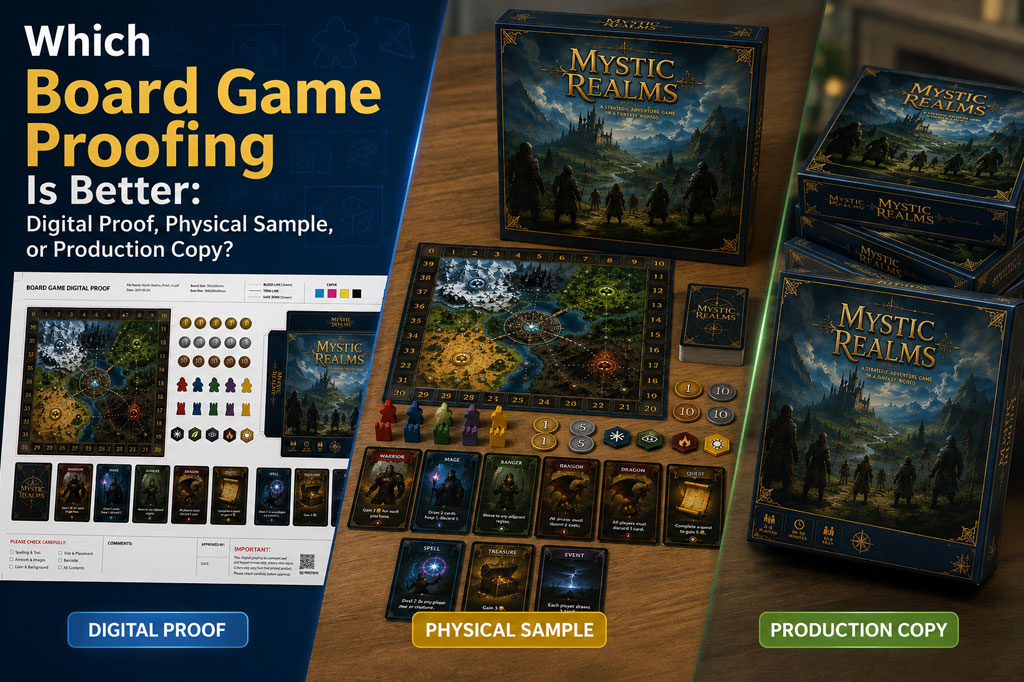
Manufacturers usually offer three forms of proofing: a digital proof, a physical sample, and a production copy. Each serves a different purpose. The best option depends on what you need to verify, how complex your game is, and how much risk you are willing to accept.
For most board game designers, the right answer is not to choose only one. It is to use proofing as a sequence: digital proof first, physical sample when necessary, and a production copy before approving the full print run.
What Is a Digital Proof?
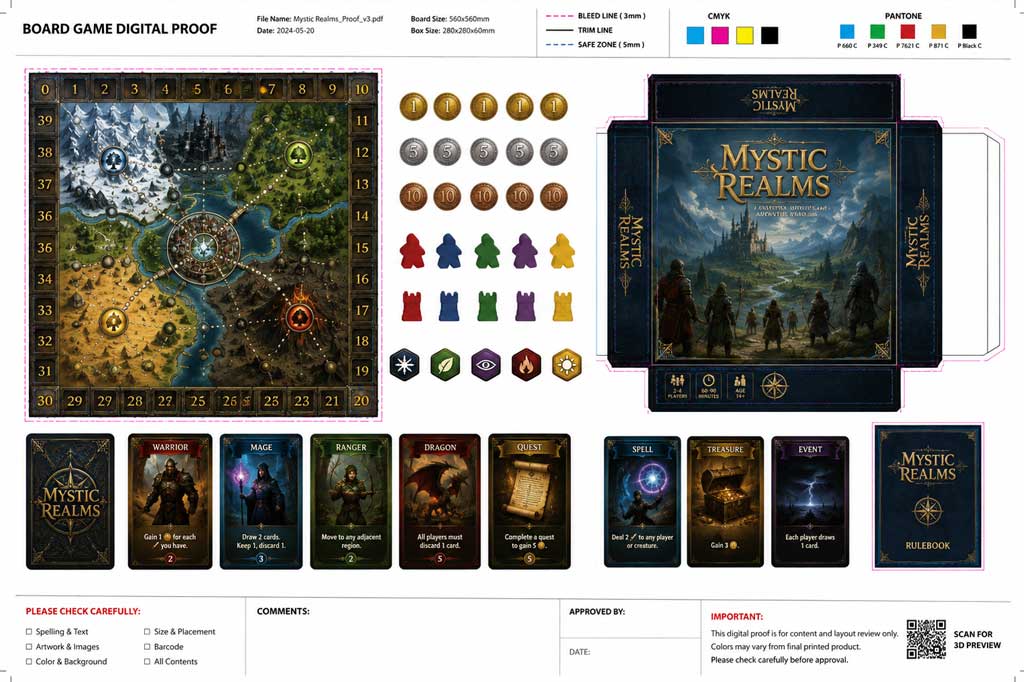
A digital proof is an electronic preview of your production files, usually supplied as a PDF or a set of rendered images. It shows how the manufacturer has interpreted and prepared your artwork for printing and cutting.
A digital proof can help you check:
- Component dimensions
- Artwork orientation
- Bleed and safe areas
- Cut and fold lines
- Card fronts and backs
- Page order
- Color modes and embedded images
- Missing fonts or graphics
- Barcode and legal-text placement
Digital proofs are fast, inexpensive, and easy to share with editors, artists, and other team members. They are particularly useful for catching technical file errors before the manufacturer invests time and materials in a physical sample.
However, a digital proof cannot reliably show how the final product will feel. Your monitor cannot reproduce the exact appearance of printed ink, paper texture, lamination, varnish, foil, or wood. It also cannot tell you whether cards will shuffle smoothly, whether tokens are easy to punch, or whether every component fits inside the box.
When a Digital Proof Is Enough
A digital proof may be sufficient when:
- The game uses familiar, previously tested materials.
- The manufacturer has produced the same component specifications before.
- The project is a small reprint with only minor artwork changes.
- The print quantity and financial risk are low.
- Color accuracy is not critical.
- The designer already has physical samples of the selected materials.
Even in these situations, approval should be careful. Review the proof at actual size, not only with the page scaled to fit your screen.
What Is a Physical Sample?
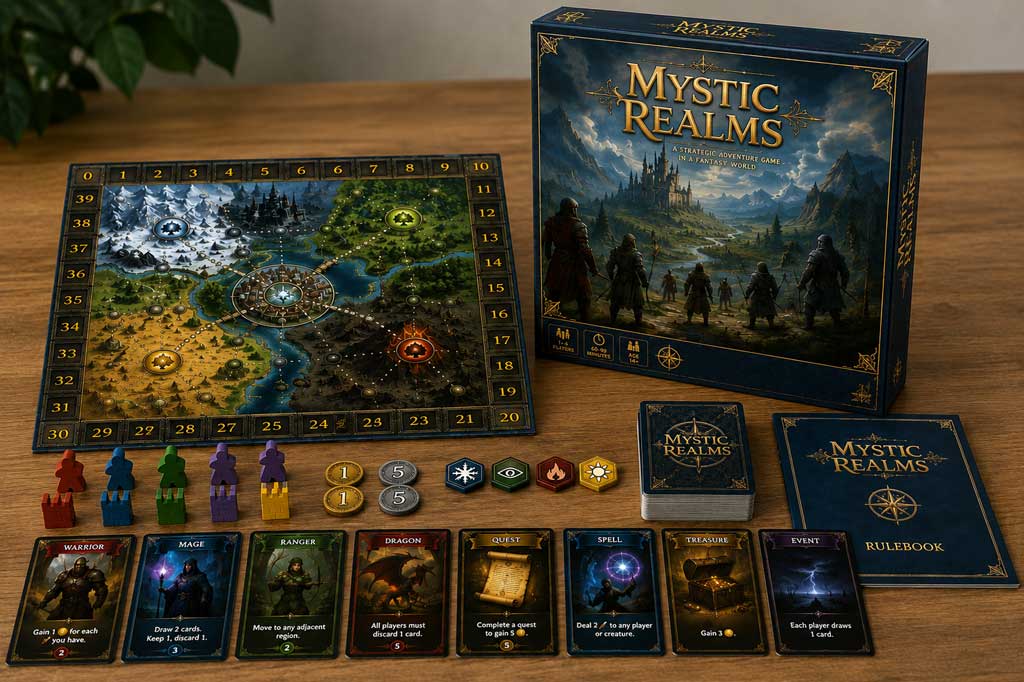
A physical sample is a tangible version of the game or some of its components. It is often produced with digital printing, hand cutting, prototype equipment, or a combination of production and non-production methods.
Depending on the manufacturer, the sample may include:
- A complete assembled game
- Printed cards and boards
- A finished box
- Punchboards
- Rulebooks
- Material swatches
- Generic components combined with custom-printed pieces
A physical sample allows you to evaluate qualities that cannot be judged accurately through a PDF. You can inspect text size, contrast, component scale, box fit, paper thickness, surface finish, and overall usability.
It also gives you another opportunity to play the game in something close to its commercial form. This frequently reveals problems that were invisible during prototype testing. Cards may be difficult to hold in large hands. Resource tokens may look too similar across the table. A board area that appeared spacious on screen may become crowded during play.
The Limitations of a Physical Sample
A physical sample is not always identical to the mass-produced game. The manufacturer may use a different printing process, substitute materials, or cut components by hand. Colors, edge quality, punch resistance, and finish may therefore differ from the final product.
Before approving a sample, ask the manufacturer which features are production-representative and which are only approximations.
A physical sample is most valuable when you need to verify:
- Readability at actual size
- Color contrast between game elements
- Card and board dimensions
- Component ergonomics
- Material choices
- Box dimensions and insert layout
- Overall presentation
- Practical playability
What Is a Production Copy?
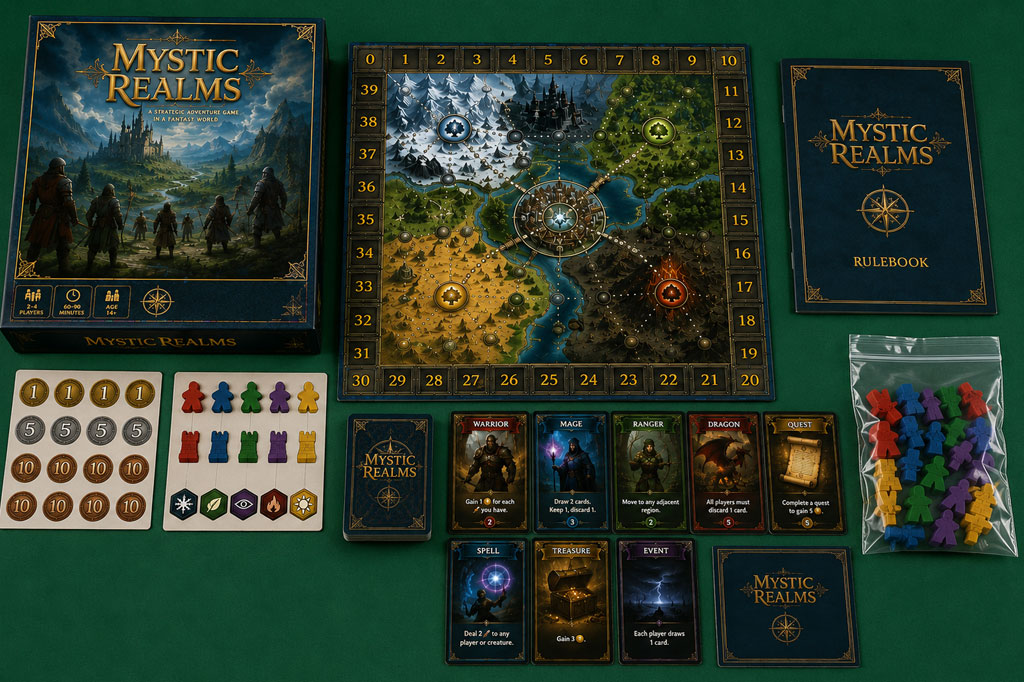
A production copy—sometimes called a pre-production sample or production proof—is made using the same or nearly the same materials, equipment, and processes intended for mass production.
This is the closest preview of the final retail game. It may include production printing, die cutting, lamination, binding, assembly, and packaging. In some projects, it is created before the full run begins. In others, the manufacturer provides copies taken from the first units produced.
A production copy is the strongest proof for confirming:
- Final color reproduction
- Print registration
- Die-cut accuracy
- Punchboard quality
- Card finish and handling
- Board folding and alignment
- Box construction
- Insert fit
- Component packing
- Special finishes
- Overall manufacturing quality
It is also the most expensive and time-consuming proof. Creating a production copy may require the manufacturer to prepare plates, dies, molds, or machine setups. If you request changes after these tools have been made, additional fees and delays may follow.
Digital Proof vs. Physical Sample vs. Production Copy
| Proof type | Best for | Main limitation | Relative cost | Typical speed |
|---|---|---|---|---|
| Digital proof | File setup, layout, bleed, orientation and content | Cannot verify materials or real-world color | Low | Fast |
| Physical sample | Size, readability, usability, materials and box fit | May use non-production processes | Medium | Moderate |
| Production copy | Final manufacturing quality and special finishes | Expensive and may arrive late in the schedule | High | Slow |
Which Proofing Option Is Better?
The best proofing strategy is a staged one.
Stage 1: Approve the Digital Proof
Use the digital proof to eliminate technical and content errors. Confirm that the manufacturer is working from the correct file version and that every component has been imposed, oriented, and paired properly.
Do not treat this as a quick visual inspection. Check every page, card, tile, and panel systematically.
Stage 2: Evaluate a Physical Sample
Request a physical sample when the game includes unfamiliar materials, tightly packed components, small text, unusual formats, or complex user interactions.
Test it as a product, not merely as a display object. Set it up, teach it, play it, pack it away, and ask people who were not involved in development to use it.
Stage 3: Approve a Production Copy
For a large or high-value print run, request a production copy made with final processes. It is especially important when the game includes:
- Custom inserts
- Miniatures
- Magnetic components
- Foil stamping
- Spot UV
- Linen or other textured finishes
- Multi-layer boards
- Unusual box structures
- Strict brand colors
- Complex punchboards
If possible, require written approval of the production copy before mass production proceeds.