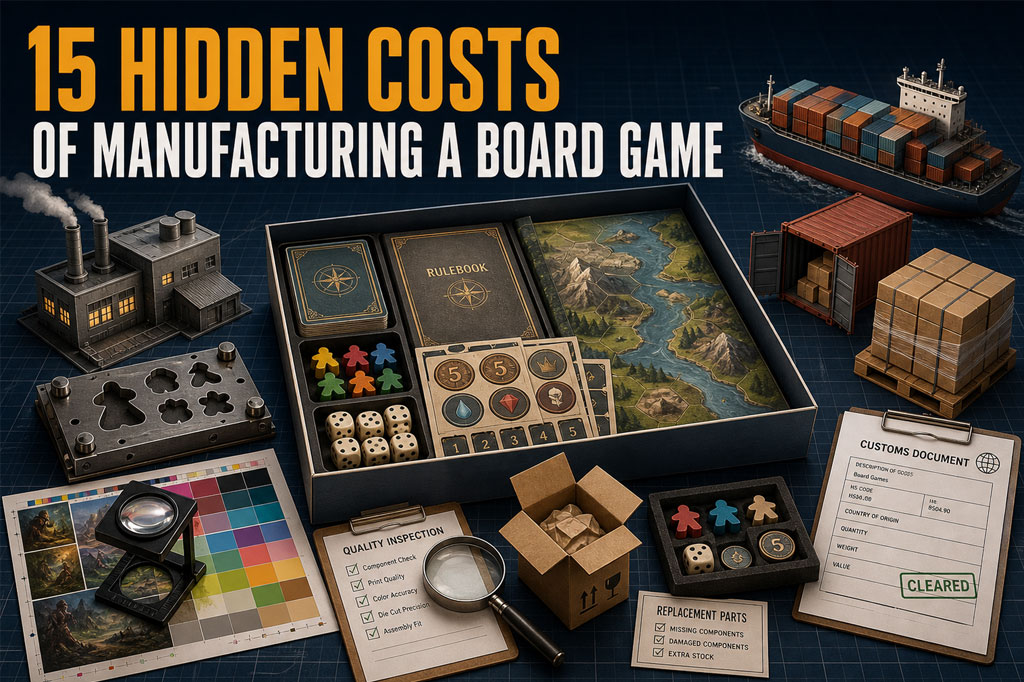
Designing a board game is creative work, but manufacturing one is an exercise in managing thousands of physical details. New designers often compare factories by looking at the quoted unit price: the amount charged to manufacture each copy. Unfortunately, that figure rarely represents the complete cost of producing a sellable game.
Expenses can appear during component preparation, pre-production, freight, customs clearance, assembly, warehousing, and quality control. A small design decision—such as adding a unique card size or using a larger box—can create additional costs throughout the entire supply chain.
Understanding these hidden costs before requesting quotations will help you build a realistic budget, communicate more effectively with manufacturers, and protect your profit margin.
Here are 15 manufacturing costs that every board game designer should anticipate.
| Hidden cost | When it usually appears | Main risk |
|---|---|---|
| 1. Prototypes and samples | Pre-production | Repeated revision fees |
| 2. Tooling and setup | Before mass production | High one-time charges |
| 3. Custom component sizes | Quotation and production | More waste and special handling |
| 4. Artwork preparation | Prepress | File correction fees and delays |
| 5. Color matching | Sampling and printing | Inconsistent components |
| 6. Component sorting | Assembly | Higher labor costs |
| 7. Packaging materials | Production | Increased unit cost |
| 8. Safety testing | Pre-shipment | Compliance failure |
| 9. Overproduction allowance | Production | Paying for unusable copies |
| 10. Quality inspections | During and after production | Defects discovered too late |
| 11. Freight packaging | Before shipping | Greater volume and weight |
| 12. Shipping volatility | Transportation | Budget overruns |
| 13. Customs and duties | Importation | Unexpected landed costs |
| 14. Warehousing | After arrival | Recurring storage fees |
| 15. Replacements and support | After fulfillment | Long-term service expenses |
1. Prototypes and Pre-Production Samples
A playable prototype made at home is not the same as a factory sample. Manufacturers may charge for white samples, printed prototypes, component samples, and final pre-production copies. International shipping for these samples can sometimes cost more than the samples themselves.
One round of sampling is rarely enough. Incorrect colors, weak materials, unclear icons, or poorly fitting inserts may require another version. Include several sample rounds in your budget, especially if your game contains miniatures, unusual packaging, or unfamiliar materials.
2. Tooling, Dies, Molds, and Setup
Standard cards and punchboards can usually be produced with existing equipment. Custom components often require new cutting dies, plastic molds, wooden shapes, embossing plates, or printing screens.
These are one-time costs, but they can be substantial. A custom plastic miniature, for example, requires more than sculpting: it may also need mold engineering, test shots, adjustments, and production setup. Before approving a custom component, ask whether an existing factory shape could provide the same gameplay function.
3. Non-Standard Component Sizes
A component that is only slightly larger than a standard size may be surprisingly expensive. Factories arrange cards, boards, and tokens on large production sheets. Standard dimensions are designed to use those sheets efficiently.
An unusual card or board size can create material waste, require special cutting, or reduce the number of components produced in each machine cycle. It may also eliminate access to standard sleeves, inserts, cartons, and packaging equipment. Request the manufacturer’s preferred dimensions before finalizing component specifications.
4. Artwork Preparation and Prepress Corrections
Print-ready artwork requires correct bleed, color settings, resolution, dielines, safety margins, and font handling. Files that look perfect on a monitor may not be suitable for commercial printing.
Some manufacturers include basic file checking, but extensive corrections may be billed separately. Even when corrections are free, they can delay production. Designers should use the factory’s official templates and arrange an independent preflight check before submission. Remember that every last-minute text change may need to be updated across cards, rulebooks, boxes, and reference sheets.
5. Color Matching Across Materials
Your game’s signature blue may appear differently on cards, punchboard, plastic pieces, and the box. Each material absorbs or reflects color in a different way, while separate components may be printed on different machines.
Achieving close color consistency can require physical proofs, Pantone matching, additional press checks, or several sample rounds. These services increase both cost and production time. Decide early which colors must match exactly and where minor variation is acceptable. Functional information should never depend on a subtle color difference alone.
6. Sorting and Assembly Labor
A quotation may include component production without including all the labor needed to create a finished game. Workers may need to count cards, separate tokens, bag resources, attach stickers, fold boards, place components into inserts, and shrink-wrap boxes.
The more unique component groups you have, the more complicated this process becomes. Requiring exactly 17 red cubes, 13 blue cubes, and six specially packed token sets creates opportunities for counting errors. Simplifying component quantities and bagging instructions can reduce both labor charges and defect rates.
7. Bags, Inserts, Wrapping, and Internal Packaging
Small packaging items are easy to overlook because they are not part of gameplay. Nevertheless, plastic bags, paper bands, card wells, molded inserts, tissue, foam sheets, shrink-wrap, seals, and protective films all have a cost.
A custom insert may also require tooling and extra assembly. Before commissioning one, confirm that it works with sleeved cards if your audience is likely to use them. Good internal packaging should protect the game during transportation without adding unnecessary weight, plastic, or box volume.
8. Product Testing and Regulatory Compliance
Games sold in different markets may need to meet rules concerning toy safety, labeling, chemical content, small parts, packaging, and age grading. Laboratory testing is generally separate from the factory’s production price.
Testing becomes more complicated when a game includes paint, magnets, electronics, metal, fabrics, or components designed for children. A failed test can force you to change materials, repeat production, or pay for another laboratory evaluation. Identify your target markets and compliance requirements before mass production begins—not after the games are already packed.
9. Production Tolerances and Unusable Copies
Factories normally work within agreed manufacturing tolerances. A production order for 5,000 games may not result in exactly 5,000 perfect retail copies. Some components may be damaged during printing, cutting, assembly, or packing.
Manufacturers may produce extra units or loose components to compensate, but the policy varies. Ask whether the quotation allows quantity variation and whether you will be charged for overproduction. You should also reserve games for reviewers, replacements, promotional use, and lost shipments rather than assuming every manufactured copy can be sold.
10. Quality-Control Inspections
Relying entirely on a finished sample is risky because that sample may not represent the full production run. Cards can be collated incorrectly, tokens can shift off-center, boxes can split, and entire cartons can contain missing components.
Independent inspection adds cost, but discovering a major problem after importing thousands of games is far more expensive. A useful inspection plan defines measurable standards for print quality, component counts, assembly, packaging, and carton condition. For complex games, inspection should occur during production as well as before shipment.
11. Export Cartons and Protective Freight Packaging
Retail packaging is designed to attract customers; freight packaging is designed to survive warehouses, containers, forklifts, moisture, and stacking pressure. Export cartons, dividers, corner protection, pallet wrap, desiccants, and reinforced packaging may not appear in the initial unit quote.
Changing the number of games packed in each carton also changes carton weight and dimensions. Extremely heavy cartons can be difficult to handle, while inefficient cartons waste container space. Ask for master-carton specifications before approving the retail box.
12. Freight Price and Capacity Changes
A freight estimate is only an estimate until transportation is booked. Ocean, rail, air, and truck rates can change because of fuel prices, seasonal demand, port congestion, capacity shortages, and routing disruptions.
Production delays can make the situation worse. If games miss their planned vessel or must reach backers before a promised date, expensive air freight may become the only practical option. Build a freight contingency into the budget and avoid making fulfillment promises based on the factory completion date alone.
13. Customs Duties, Taxes, and Clearance Fees
The factory price is not the landed cost. Imported games may generate customs duties, import taxes, brokerage charges, documentation fees, port handling fees, examination costs, and delivery charges.
Classification also matters. A game containing electronic or unusual components may be treated differently from a conventional board game. Designers should obtain a landed-cost estimate from a qualified freight forwarder or customs broker. Do not assume that “shipping included” means duties, taxes, customs clearance, and final delivery are all included.
14. Storage, Handling, and Long-Term Warehousing
When games reach a warehouse, expenses continue. Warehouses can charge for receiving, pallet preparation, monthly storage, inventory counts, labeling, order handling, and disposal. Slow-selling inventory may eventually cost more to store than it is worth.
Oversized boxes amplify this problem because fewer units fit on a pallet or shelf. Before increasing the box to create stronger retail presence, calculate its effect on freight, storage, and fulfillment. A compact box is often one of the most effective cost-saving design decisions.
15. Replacement Parts and Post-Production Support
Manufacturing responsibility does not end when the product ships. Customers may receive games with missing cards, damaged boxes, warped boards, or incorrect tokens. Replacement parts require spare inventory, storage space, envelopes, labor, and postage.
Ask the factory to supply extra quantities of vulnerable components. Create a simple system for identifying versions, production batches, and replacement parts. If you expect multiple language editions, keep their components clearly separated. Supporting a game professionally protects your reputation, but that support must be included in the project budget.