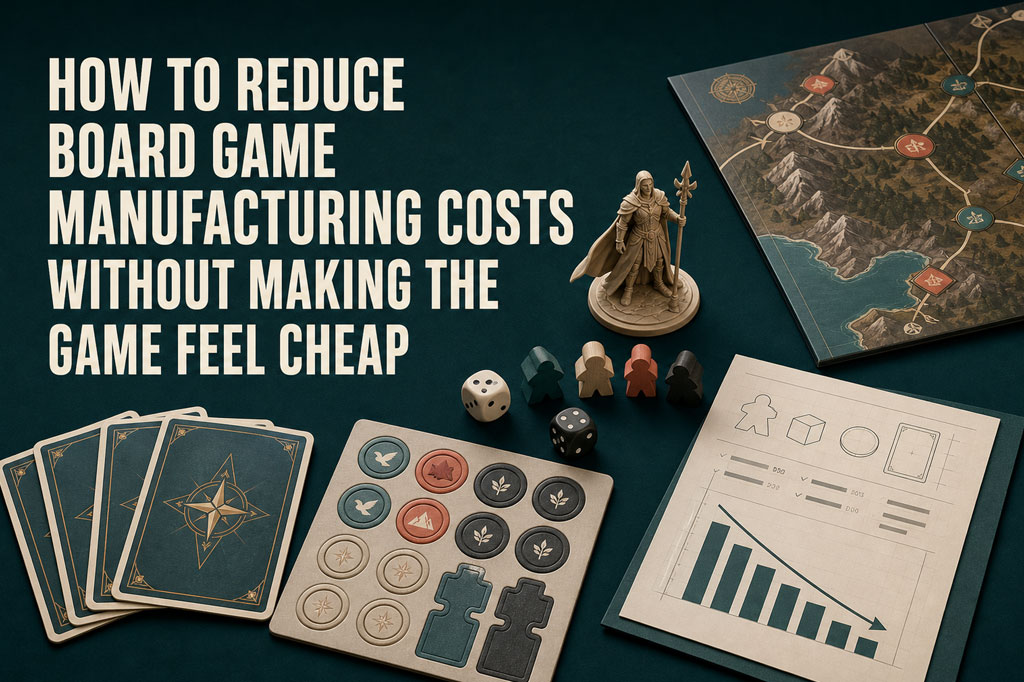
Reducing manufacturing costs does not mean lowering quality everywhere. The goal is to spend money on the components players notice and remove costs they rarely appreciate.
Protect the Player-Facing Experience
Before cutting anything, identify the game’s most important physical interactions:
- What do players hold most often?
- Which components appear prominently on the table?
- What creates the strongest first impression?
- Which pieces must remain durable or easy to read?
Preserve quality in these areas. Simplify components that are rarely handled, mostly decorative, or hidden during play.
Choose Components by Function
Use the least expensive component that still performs its job well.
| Component | Cost-saving approach | Quality to protect |
|---|---|---|
| Cards | Use standard sizes and reduce unnecessary decks | Finish, readability and shuffling |
| Tokens | Combine similar shapes and minimize custom punchboards | Clear iconography and adequate thickness |
| Boards | Use fewer folds or modular tiles | Flatness and print clarity |
| Dice | Use standard engraved dice with stickers or reference cards | Legibility |
| Miniatures | Replace minor figures with standees or wooden pieces | Keep miniatures for important characters |
| Inserts | Use folded cardboard or a simple tray | Fast setup and organized storage |
| Rulebook | Reduce page count through better editing | Examples, diagrams and readable type |
A well-designed cardboard standee is better than a poorly detailed miniature. Players judge whether a component feels intentional—not simply whether it is expensive.
Reduce the Number of Unique Parts
Every unique component can add setup, tooling, assembly and quality-control costs.
Look for opportunities to:
- Use one token shape in several colors.
- Print variable information on cards instead of custom pieces.
- Track values with shared cubes rather than dedicated markers.
- Replace multiple reference sheets with double-sided player aids.
- Use repeated tile sizes to simplify punching and packing.
Standardization can also make the game easier to learn.
Design Around Standard Specifications
Custom dimensions often create costs without adding meaningful value. Whenever possible, use:
- Standard card and sleeve sizes
- Common box dimensions
- Existing dice and wooden-piece shapes
- Printer-friendly sheet layouts
- Conventional board and punchboard thicknesses
Ask manufacturers for their preferred specifications before finalizing component dimensions. A change of only a few millimeters may allow more cards or tokens to fit on each production sheet.
Optimize the Box
Oversized boxes increase material, assembly, freight, warehousing and fulfillment costs. They may also make a modest component set feel sparse.
Choose the smallest box that can comfortably hold:
- All components
- A practical insert
- Sleeved cards, if sleeve support matters
- Any promised expansions
A compact box filled with well-organized components usually feels more premium than a large box containing empty space.
Improve Layout Efficiency
Manufacturers commonly price printed components by sheets, boards or molds—not by the exact number of items used.
Review each production layout:
- Can more tokens fit on one punchboard?
- Can a card deck stay below the next sheet threshold?
- Can two small boards become one double-sided board?
- Can low-value components be removed entirely?
- Can the same mold or cutting pattern serve multiple pieces?
One fewer punchboard or print sheet can save more than making every component slightly thinner.
Use Premium Features Selectively
Premium finishes are most effective when they create a clear focal point.
Good candidates include:
- A linen finish on frequently handled cards
- One distinctive first-player marker
- A high-quality central board
- Screen-printed resources used throughout the game
- Spot effects on the box cover
Avoid applying upgrades uniformly. Foiling every card or creating a custom miniature for every unit increases cost while reducing the impact of each special feature.
Cut Complexity Before Cutting Material Quality
Assembly-heavy products can be expensive even when their materials are inexpensive. Costs rise with individually packed decks, numerous bags, preassembled parts and complicated inserts.
Simplify by:
- Reducing separate component groups
- Limiting individually wrapped decks
- Using fewer bag sizes
- Avoiding components that require manual assembly
- Designing an insert that works in one orientation
This lowers labor costs without changing what players see during play.
Compare Savings Against Player Impact
Evaluate every proposed change with a simple matrix:
| Low player impact | High player impact | |
|---|---|---|
| High savings | Implement first | Prototype and test carefully |
| Low savings | Consider if easy | Usually avoid |
Removing an unused tray may offer meaningful savings with little impact. Making all cards thinner may save less while affecting every turn.
Prototype the Cost-Reduced Version
Do not evaluate changes only in a spreadsheet. Build a prototype using the proposed materials and specifications, then test:
- Component handling
- Setup and cleanup
- Table presence
- Readability
- Durability
- Box organization
Ask testers what feels awkward or low quality without telling them where costs were reduced. If they do not notice a change, the saving is probably safe.
Final Manufacturing Checklist
Before requesting quotations, confirm that:
- Every component supports gameplay or presentation.
- Card, tile and box dimensions follow common standards.
- Printed sheets are used efficiently.
- The box contains minimal empty space.
- Unique molds and shapes are limited.
- Premium finishes emphasize only key components.
- Setup and packing requirements are simple.
- Multiple manufacturers receive the same specification sheet.
The best cost reduction is invisible. Players should experience a game that feels focused, durable and thoughtfully produced—not a product that merely contains fewer expensive components.