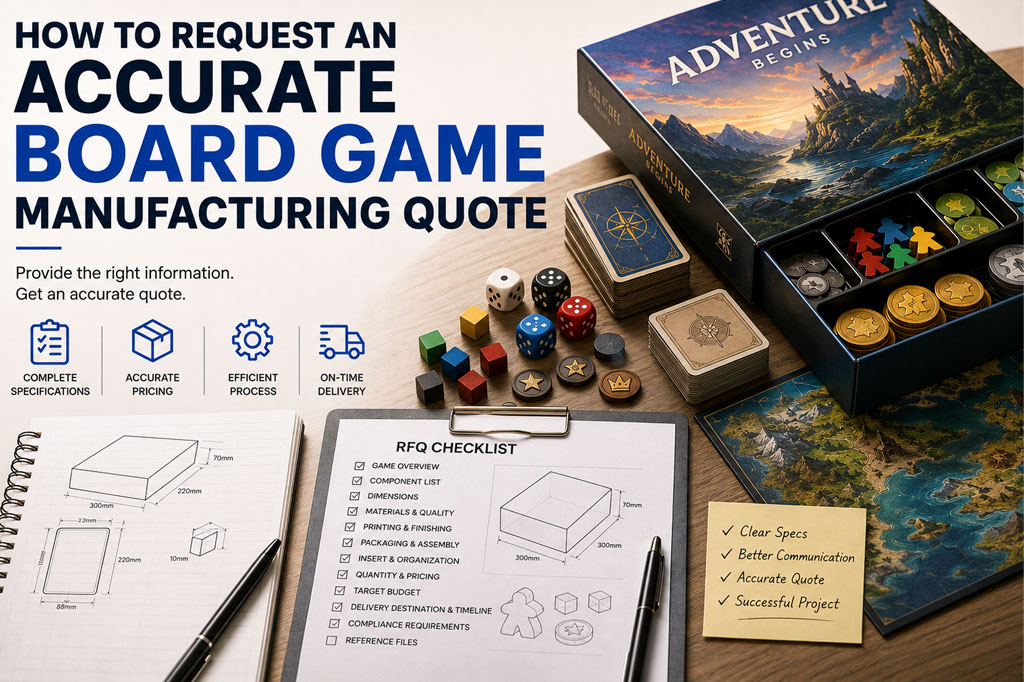
At Hicreate Games, we manufacture custom board games for designers, publishers, and crowdfunding creators. One of the first questions we receive is:
“How much will it cost to manufacture my board game?”
To provide an accurate answer, we need more than a general description or a photo of the prototype. Every component—from card stock and punchboard thickness to packaging and assembly—can affect the final price.
The more complete your specifications are, the fewer assumptions we need to make. This guide explains what information to send us so we can prepare a realistic and transparent manufacturing quote for your project.
1. Introduce Your Game and Its Production Stage
Start by giving us a short overview of your project. Tell us:
- What type of game you are creating
- Which countries or regions you plan to sell it in
- Whether it is intended for children or adults
- Your estimated production quantity
- Your target delivery date
- Whether the game has already been manufactured
- Whether your specifications and artwork are final
You do not need finished artwork to request an initial quote. We can usually prepare an estimate using a component spreadsheet, prototype photographs, sketches, draft dielines, or digital files.
However, please let us know which details are confirmed and which may still change. If the specifications are preliminary, our first quote should also be treated as preliminary.
2. Send Us a Complete Component List
The component list—also known as a bill of materials—is the foundation of an accurate board game quote.
List every physical item included in one copy of the game. For example:
- 1 rigid game box
- 1 folding game board
- 180 cards
- 4 punchboards
- 6 wooden player pieces
- 40 wooden resource tokens
- 12 custom dice
- 1 cloth bag
- 1 plastic insert
- 1 rulebook
Please include items that are easy to overlook, such as reference cards, score pads, stickers, zip bags, cardboard spacers, advertising cards, shrink wrap, and sealing labels.
Quantities should be as precise as possible. Instead of writing “some wooden tokens,” tell us how many tokens are included in each game and how many different shapes or colors are required.
Different designs can also affect production. For example, if your game contains 180 cards, let us know whether they belong to one deck or several decks, how many card-back designs they use, and whether they need to be sorted or wrapped separately.
3. Provide the Dimensions of Every Component
Descriptions such as “standard cards” or “a medium-sized box” can mean different things to different manufacturers. For accurate pricing, we recommend providing measurements in millimeters.
A component list might include:
| Component | Quantity | Finished size |
|---|---|---|
| Playing cards | 180 | 63 × 88 mm |
| Game board | 1 | 560 × 560 mm open |
| Punchboards | 4 | 250 × 250 mm |
| Rulebook | 1 | 210 × 210 mm |
| Game box | 1 | 300 × 300 × 70 mm |
| Wooden cubes | 40 | 10 × 10 × 10 mm |
For folding components, provide both the open and folded dimensions. For example, tell us whether a game board is half-folded, quarter-folded, or folded into six panels.
For punchboards, include the board dimensions, number of sheets, approximate number of tokens, and token sizes. If the pieces have custom shapes, send us a sketch or preliminary cut-line file.
Custom wooden, plastic, or metal pieces should also have dimensioned drawings. Even a simple sketch showing the length, width, and thickness can help us calculate a more reliable price.
4. Describe the Materials and Quality Level
Two components with the same dimensions can have very different manufacturing costs if they use different materials.
For each component, tell us as much as you know about the desired material, thickness, weight, construction, and finish.
Cards
For cards, useful information includes:
- Card dimensions
- Number of cards
- Card stock or preferred thickness
- White, blue, black, or another core
- Smooth or linen finish
- Varnish or lamination
- Rounded corners
- Number of face and back designs
- Deck sorting and wrapping requirements
If you are unsure about the correct card stock, tell us how the cards will be used and we will give some professional suggestions.
Game boards and punchboards
For cardboard components, please specify:
- Finished dimensions
- Thickness
- Printed paper or wrap
- Single-sided or double-sided printing
- Surface finish
- Folding structure
- Number and shape of punched pieces
When possible, describe the finished component rather than providing only the paper weight. A mounted game board consists of several material layers, so its total thickness is different from the weight of its printed paper.
Wooden components
For wooden pieces, tell us:
- Quantity per game
- Size and thickness
- Stock or custom shape
- Number of colors
- Painting or staining requirements
- Screen printing, heat transfer, or other decoration
- Number of printed sides
A stock wooden cube in a standard color will usually cost less than a custom-shaped wooden piece with multicolor printing.
Plastic, resin, and metal components
Custom plastic miniatures, resin pieces, coins, and metal components may require molds or other tooling. To evaluate them, we may need:
- 2D dimensioned drawings
- 3D files
- Reference images
- Material requirements
- Component weight
- Color information
- Surface texture
- Painting or printing requirements
If the final 3D files are not ready, reference images and approximate dimensions can still help us prepare an initial estimate.
5. Tell Us How Each Component Should Be Printed
Please specify whether each component is printed on one side or both sides and whether it requires full-color printing, spot colors, or special effects.
Possible printing and finishing options include:
- Matte or gloss varnish
- Matte or gloss lamination
- Linen texture
- Spot UV coating
- Foil stamping
- Embossing or debossing
- Metallic ink
- Edge printing
- Gilded card edges
These treatments can improve the appearance of a game, but they may also increase the unit price, setup cost, production time, or minimum order quantity.
If you are working within a target budget, let us know. We can quote the premium option separately or recommend a more economical production method that preserves the intended player experience.
6. Explain How the Game Should Be Packed
Manufacturing does not end when the individual components are printed. We also need to understand how they should be sorted, assembled, and placed inside the game box.
Please tell us:
- Whether cards should be packed as one deck or several decks
- Whether decks require paper bands, shrink wrapping, or tuck boxes
- Whether tokens should be packed together or separated
- Whether wooden pieces require individual bags
- Whether components must be sorted into player-specific sets
- Whether the final box requires shrink wrap or sealing stickers
- Whether any components must be assembled before packing
Custom assembly can affect labor costs. For example, placing 40 wooden cubes into one bag requires less work than sorting them by color into six different player packs.
A clear packing diagram is extremely helpful. It does not need to be professionally designed—a labeled photo or sketch can show us how you expect the components to be organized.
7. Specify the Insert
If your game requires an insert, tell us which type you prefer:
- Folded cardboard insert
- Vacuum-formed plastic tray
- Molded pulp insert
- EVA foam insert
- Cardboard well or spacer
- Custom plastic insert
The insert should be designed after the dimensions of all components are confirmed. It must fit both the box and the finished components—not only the digital dimensions shown in the artwork.
Please also tell us if the insert should accommodate sleeved cards. Card sleeves increase the width and thickness of a deck and may require larger card wells.
If you are unsure which insert is suitable, send us your component list and describe how you want the game to be organized. We can discuss options based on your component structure and budget.
8. Request Prices at Several Quantities
The unit price of a board game depends heavily on the production quantity. We recommend requesting quotes at several realistic quantities, such as:
- 1,000 copies
- 1,500 copies
- 2,500 copies
- 5,000 copies
Quoting several quantities allows you to see how the unit price changes as the print run increases. It can also help you identify a suitable balance between manufacturing cost and inventory risk.
Some custom components may also have their own minimum order quantities. When this happens, we will identify the relevant component and discuss the available options with you.
9. Share Your Target Budget
You are not required to provide a budget, but doing so can make the quoting process more efficient.
A target manufacturing cost helps us understand whether your current specifications are realistic. If the estimated cost is too high, we can explore adjustments such as:
- Reducing the box size
- Using stock components
- Simplifying custom shapes
- Reducing the number of punchboards
- Changing the insert material
- Removing nonessential finishes
- Combining decks or packaging steps
- Adjusting material thickness where appropriate
Our goal is not simply to manufacture every item exactly as described. It is to help you find a practical production solution that supports the game’s design, presentation, and commercial goals.
10. Ask for One-Time Costs to Be Listed Separately
Some projects require tooling or setup charges that do not repeat in the same way as the unit manufacturing cost.
These may include:
- Cutting dies
- Plastic injection molds
- Custom dice molds
- Wooden cutting tools
- Insert tooling
- Printing setup
- Pre-production samples
- Color proofs
- Product testing
When reviewing our quotations, distinguish these one-time expenses from the price per finished game. This will help you estimate both your first print run and potential reprints.
If your game includes custom tooling, ask whether the tooling can be reused for future orders and whether any storage, maintenance, or replacement conditions apply.
11. Provide the Delivery Destination
To estimate shipping, we need the complete destination details. Ideally, provide:
- Destination country
- City and postal code
- Warehouse or fulfillment-center requirements
- Whether the order will be delivered to one or several locations
A manufacturing quote and a delivered quote are not the same. We can discuss different shipping arrangements depending on your needs.
Common shipping terms include:
- EXW: The buyer arranges collection from the factory.
- FOB: The shipment is delivered to the named port and cleared for export.
- DDP: Delivery is quoted to a named destination with most transportation, customs, and duty responsibilities included, subject to the agreed terms.
12. Tell Us Your Required Timeline
If you have a crowdfunding campaign, convention, retail launch, or holiday deadline, include it in your RFQ.
A complete manufacturing schedule may involve:
- Specification confirmation
- Artwork and file review
- Digital proofing
- Pre-production sample creation
- Sample review and approval
- Mass production
- Quality inspection
- Freight booking
- Customs clearance
- Final delivery
Please distinguish between your desired factory-completion date and the date by which the games must arrive at the destination.
Production and shipping schedules may be affected by component complexity, custom tooling, material availability, revisions, peak manufacturing periods, and public holidays. Sharing your target date early allows us to evaluate the schedule more accurately.
13. Identify Your Target Market and Compliance Needs
Tell us where you plan to sell the game and whether it is intended for children. Product testing, labeling, and documentation requirements may differ by market and age category.
Relevant considerations may include:
- Safety testing
- Age grading
- Warning labels
- Small-parts warnings
- Country-of-origin markings
- Importer or responsible-party information
- Product traceability
- Barcodes
- Recycling and packaging symbols
Testing and certification costs may not be included in a basic manufacturing price unless they are specifically requested. Please discuss your sales markets with us so the appropriate requirements can be considered in the quote.
Game creators should obtain qualified compliance advice where necessary, particularly when producing products intended for children.
14. Send Reference Files and Prototype Photos
Visual references help us understand your game quickly. Useful files include:
- Component spreadsheets
- Prototype photographs
- Print-and-play files
- Preliminary artwork
- Dielines
- Technical drawings
- 3D models
- Packing diagrams
- Reference products
- Videos showing how a component works
When sending files, label them clearly and use consistent component names. The name used in your spreadsheet should match the name used in the corresponding artwork or drawing.
Also indicate whether each file is:
- A concept reference
- A prototype file
- A quotation file
- A final production file
This prevents an early reference document from being mistaken for an approved manufacturing specification.
A Recommended RFQ Format
You can begin your request with a short project summary:
Hello Hicreate Games,
We are developing a strategy board game for sale in the United States and European Union. Please quote 1,000, 2,500, and 5,000 copies. The attached spreadsheet contains our current component specifications. Please list the unit price, tooling, pre-production sample, testing, packaging, assembly, and shipping costs separately.
Our preferred delivery destination is [city, country, postal code], and our target delivery date is [date]. Please identify any assumptions or missing information used to prepare the quotation.
Your component spreadsheet can use the following columns:
| Field | Information to provide |
|---|---|
| Component | Name of the item |
| Quantity | Number included in each game |
| Dimensions | Finished length, width, and thickness |
| Material | Paper, cardboard, wood, plastic, metal, or fabric |
| Printing | Printed sides, colors, and number of designs |
| Finish | Varnish, lamination, linen texture, foil, etc. |
| Variations | Shapes, colors, or versions |
| Packaging | Sorting, wrapping, bagging, or assembly |
| Reference file | Matching artwork, drawing, or photograph |
| Status | Preliminary or final |
| Notes | Any additional requirements |
Final Words
An accurate board game manufacturing quote begins with clear and measurable specifications.
Send us the information you already have, clearly identify what is still undecided, and tell us what you want the final game to achieve. We can then help clarify the specifications, identify potential cost drivers, and prepare a quote that reflects the product you actually intend to manufacture.
The more accurately we understand your game, the more accurately we can quote it.