Some custom game projects begin with a quotation and move into production within a few months. Others take years to develop.
This project belongs to the second category.
We first connected with the client in 2019. Over the following years, we stayed in regular contact, providing quotations, product recommendations, and manufacturing support as their product plans evolved.
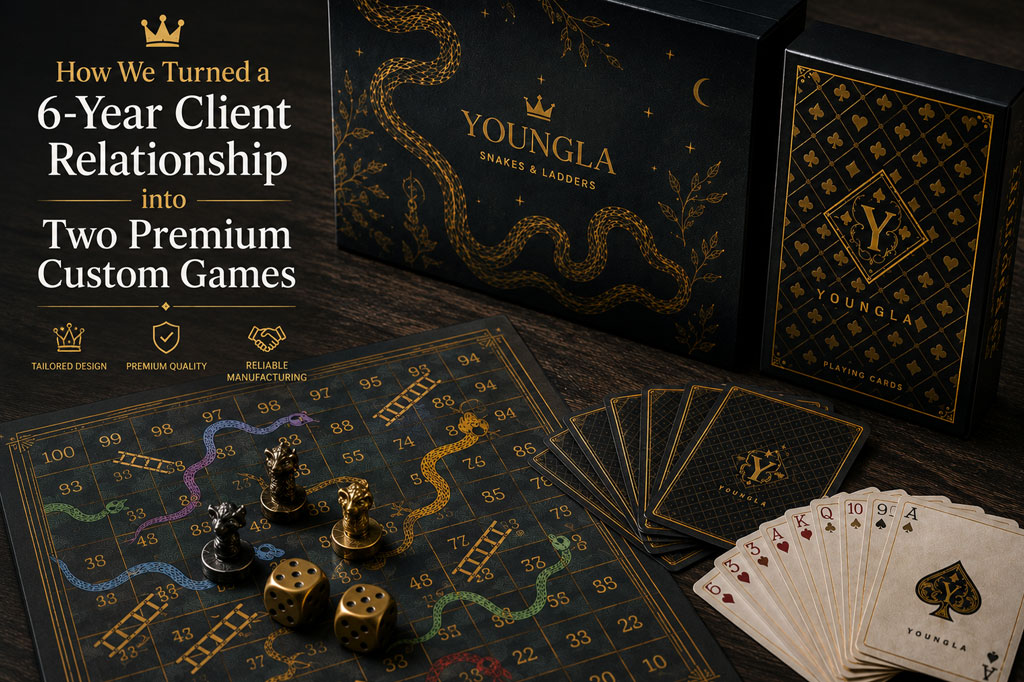
In 2025, after nearly six years of communication, the client was finally ready to move forward and entrusted us with the production of two custom game products: a premium Snakes and Ladders game and a custom poker set.
For us, this project was more than a new production order. It represented the result of years of communication, technical support, and trust-building.
Project Overview
The project consisted of two different custom game products.
Custom Snakes and Ladders Game
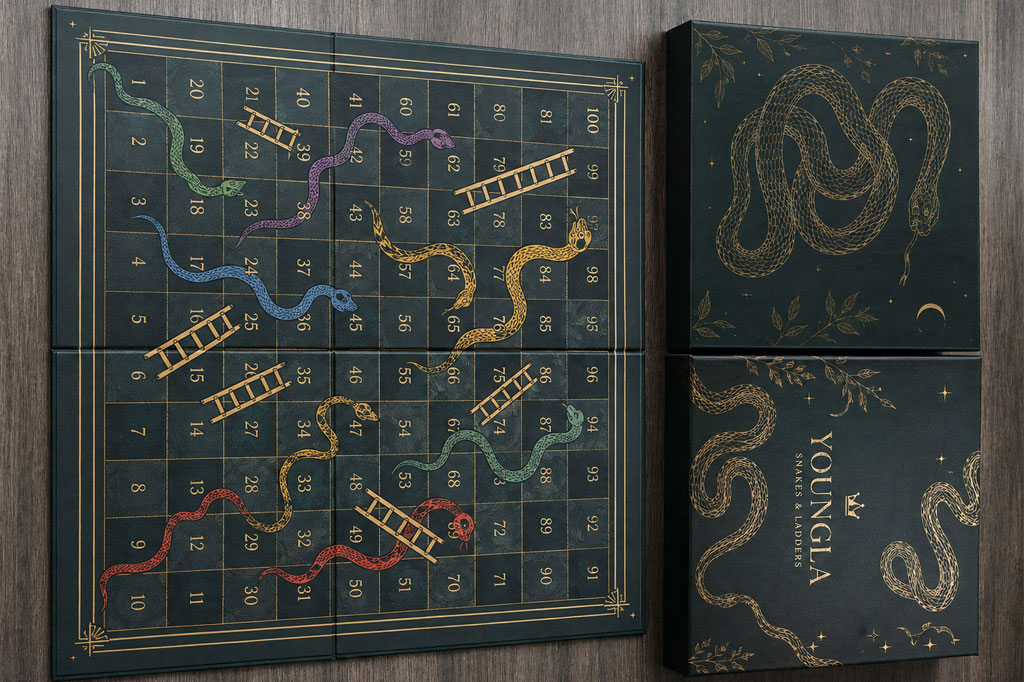
The final product included:
- Top and bottom lid box
- PU leather game board
- Custom metal game pieces
- Custom dice
- Custom plastic insert
Custom Poker Set
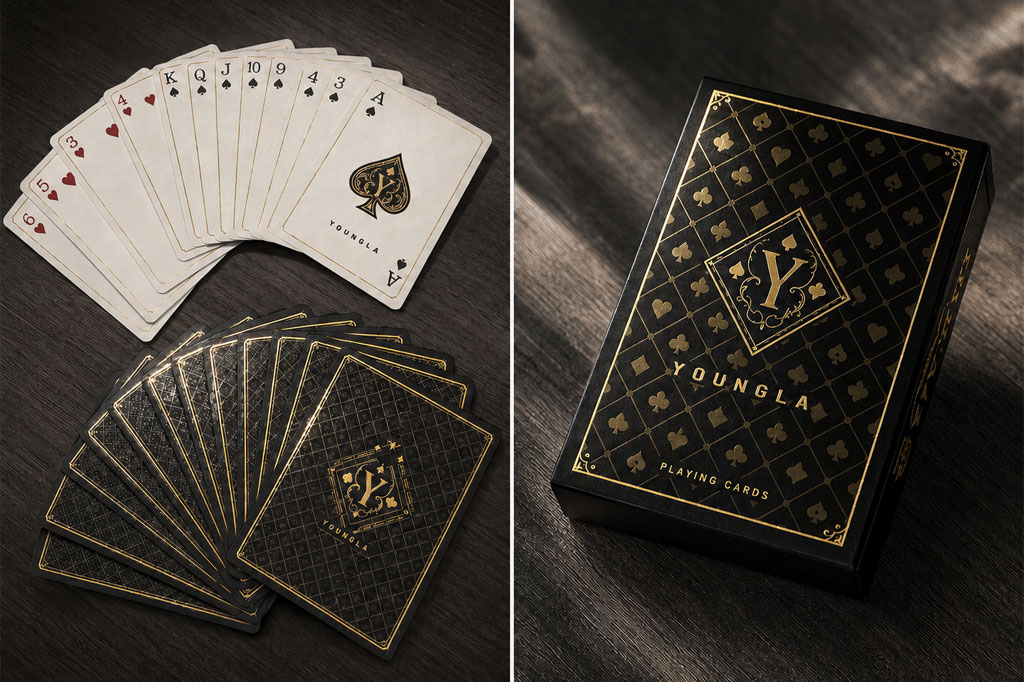
The second product included:
- Custom printed poker cards
- Magnetic flip-top rigid box
- Custom dice
These two products were developed as brand collaboration / branded merchandise products, which meant the client had higher expectations for materials, craftsmanship, presentation, and delivery reliability.
These potential requirements influenced almost every decision we made during sampling and production.
The Challenges and Solutions
The challenges were not simply manufacturing all the components correctly. It was making sure the materials, printing, packaging, and tactile experience worked together to support the client’s intended product positioning.
During prototype development, several issues became apparent.
Challenge #1. Digital Samples Did Not Fully Represent the Expected Final Result
We completed multiple rounds of digital sampling during the development process.
However, the actual appearance of these samples still differed from the result the client expected.
This can become a significant problem for premium products. If a client approves a sample that does not accurately represent the final production effect, discrepancies in printing, color, finishing, or overall presentation can become much more expensive to resolve after mass production begins.
Our Solution: From Digital Samples to Production-Ready Prototypes
After several digital sample rounds still failed to achieve the client’s expected result, we moved directly to producing a physical sample using actual production equipment and processes.
This allowed the client to evaluate a sample much closer to the intended mass-production result.
When the client received the new sample, they were very satisfied with the result, allowing us to move forward with much greater confidence.
Challenge #2. The Original Paper Game Board Did Not Feel Premium Enough
The initial plan was to use a conventional paper-based game board.
From a functional perspective, the material could work.
But once we evaluated it in the context of the client’s brand positioning, we felt that it did not provide the tactile and visual quality required for the project.
Our Solution: Upgrade to PU Leather Boards
We recommended replacing the standard paper game board with a custom PU leather board.
This change significantly improved the tactile experience of the product.
Compared with the original paper solution, the PU leather surface provided a more refined appearance and touch, making it more suitable for the client’s premium positioning.
For this project, the material upgrade was therefore not simply about using a more expensive material. It was about choosing a material that better supported the intended brand experience.
Challenge #3. Wooden Game Pieces Did Not Match the Overall Product Positioning
Wooden pieces were also considered during the early development stage.
Again, they could fulfill the basic function of the game, but their weight and appearance did not fully match the premium direction of the finished product.
We therefore needed to find an alternative that could make the product feel more substantial.
Our Solution: Upgrade to Metal Pieces
One of our key recommendations was to replace the originally considered wooden game pieces with custom metal pieces.
The reason was not simply aesthetic.
Metal pieces provide noticeably more weight when handled. This additional weight can create a stronger sense of substance and quality, helping the game feel more like a collectible or premium branded product.
The custom metal pieces also better complemented the upgraded packaging and board materials.
Challenge #4. Making the Box Match the Premium Product Positioning
Packaging was another important part of the project.
For the Snakes and Ladders game, the client selected a standard rigid lid-and-base box. But this box would not fully communicate the level of quality the client wanted.
It could not create a strong first impression and visually match the upgraded materials inside, particularly the PU leather game board and metal pieces.
Our Solution: Full-Coverage Foil Stamping Packaging Box
To further strengthen its visual impact, we recommended using full-coverage foil stamping on the packaging box.
The metallic finish helped create a more distinctive premium appearance and complemented the PU leather board and metal pieces inside.
The combination of:
Rigid box + foil stamping + PU leather board + custom metal pieces
created a much more coherent premium product than the original standard-material concept.
This was an important part of our approach throughout the project: instead of focusing on individual components in isolation, we considered how materials and finishing techniques would work together.
Challenge #5. Sample Approval and Production Had to Fit a Tight Schedule
At the same time, the project had a relatively tight sample confirmation window.
Premium customization often involves more sampling and more production variables, which can increase the risk of delays.
This created another challenge: improving materials and craftsmanship could not come at the expense of the agreed delivery schedule.
Our Solution: Optimized The Production Schedule
Because the client’s required delivery date had already been confirmed, we carefully managed the mass production schedule after final sample approval.
Once the specifications were locked, our team followed the optimized production plan and coordinated the different manufacturing stages to keep the project moving forward.
Despite the additional material and process optimization during development, mass production was completed and delivered according to the agreed schedule.
Final Results: Confidence Before the Final Sample
The client was very satisfied with the final product.
One detail in particular demonstrated the level of confidence established during the project.
Before the final round of samples had been completely finished, the client had already decided to place the mass-production order.
For us, this was meaningful because the decision was not based on a single quotation or sample.
It came after years of communication beginning in 2019, followed by hands-on cooperation during product development in 2025.
The client’s decision reflected confidence in our product quality, communication efficiency, and manufacturing capabilities.